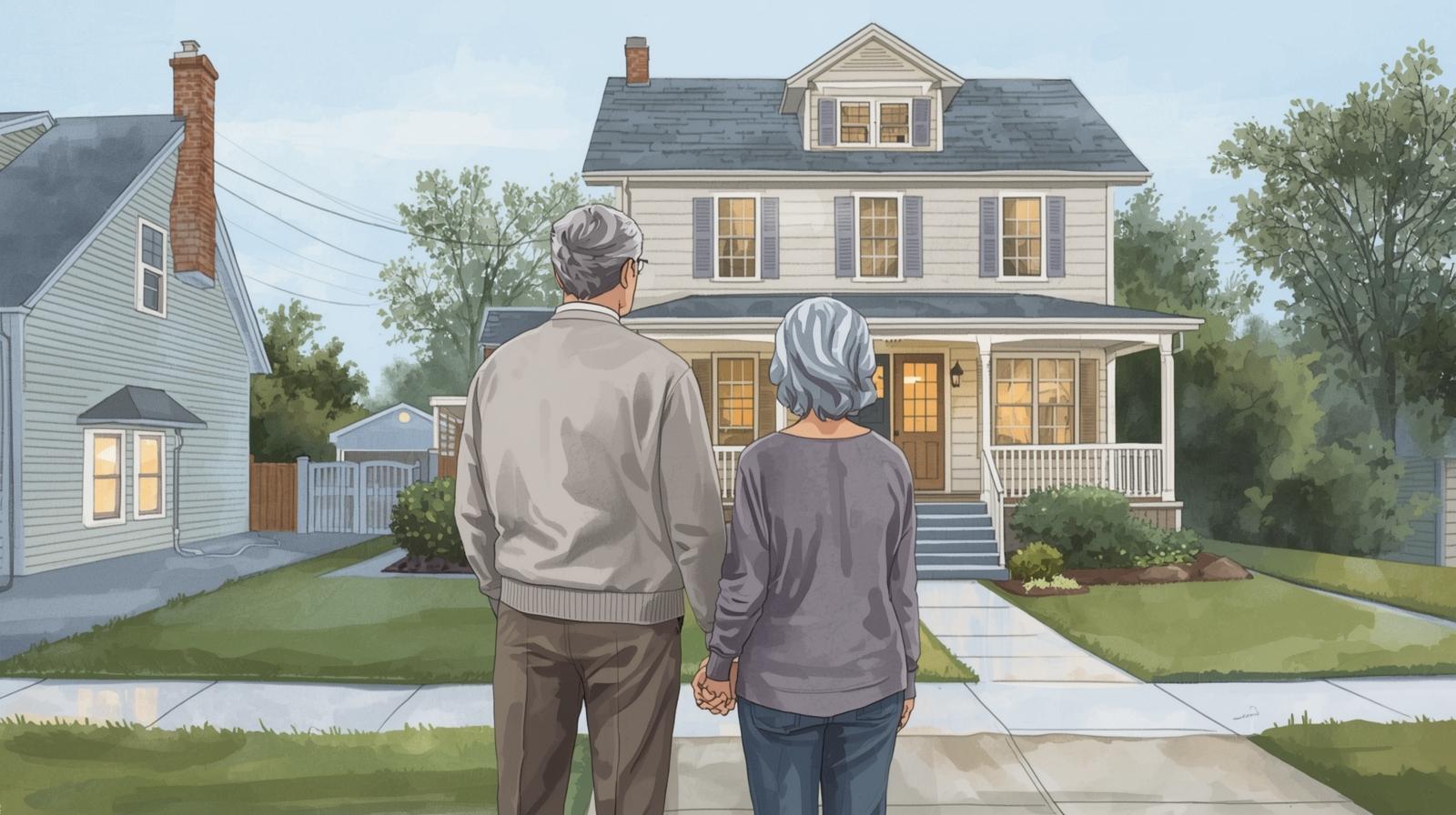
The last box is loaded into the car. Your youngest is heading off to college, a new job, or their first apartment. You stand in the driveway waving goodbye, then turn back toward a house that suddenly feels enormous and eerily quiet.
For years, every decision about this house centered on the children. You lived in the right school district, kept extra bedrooms for sleepovers, and tolerated the long commute because the neighborhood was perfect for raising kids. The house wasn’t just where you lived; it was command central for the most important project of your life.
Now everything has changed. The guardianship provisions in your twenty-year-old estate plan protect children who are now adults. The house that was essential family infrastructure feels like too much space for two people.
Your financial picture has transformed through decades of mortgage payments, retirement contributions, and home appreciation. And you’ve shifted from the invincible years of raising children to the realistic years where long-term care, nursing homes, and end-of-life planning demand attention.
The questions you face about the family home are fundamentally different now. Should you keep the house or downsize? What happens if one of you needs nursing home care and Medicaid gets involved?
Do your adult children even want to inherit this house? Will the home you spent decades paying for end up consumed by probate costs or Medicaid estate recovery instead of benefiting your family?
This article addresses those questions directly.
You’ll learn why your existing estate plan probably doesn’t protect the house the way you think it does, what happens to home equity when long-term care becomes necessary, and what planning strategies actually work for this life stage, including the narrow window you have right now before health changes eliminate your options.
Why Your Estate Plan From 20 Years Ago Doesn’t Work Anymore
The Guardian Provisions Nobody Needs Now
The estate plan you created when your children were young focused heavily on guardian appointments and trusts holding assets until kids reached certain ages.
Those provisions made perfect sense then. They’re largely irrelevant now. Your children are adults managing their own lives, and the age-based trust restrictions that once protected minors may feel patronizing to people who’ve already surpassed those milestones.
Life insurance beneficiary designations may still route proceeds through trusts designed for minors, even though your children are fully capable of managing inheritances directly.
Empty nest estate planning centers on entirely different priorities: protecting assets from long-term care costs, avoiding probate on appreciated property, and planning for gradual decline rather than sudden death. The guardian-focused plan from two decades ago addresses none of these.
The House Served a Different Purpose Then
Every square foot of the family home once served a purpose tied to raising children. Now two people occupy a four-bedroom house where most rooms sit empty. The planning question has shifted accordingly, from “who will live here if we die” to “how do we preserve this asset’s value for inheritance while managing the reality that one or both of us might need long-term care.”
Long-Term Care Wasn’t on the Radar
Estate planning in your forties assumed you’d either be fine or you’d be gone. Gradual decline requiring years of long-term care wasn’t part of the picture. It needs to be now.
Approximately 70% of people over 65 will need some form of long-term care, and nursing home costs in Missouri average $7,000 to $10,000 per month. Strategies that protect the home from nursing home costs and estate recovery require advance implementation, often five years before care is needed due to Medicaid’s lookback period.
Your Financial Picture Has Completely Changed
Navigating major life transitions means reassessing both housing needs and financial priorities. The home that once carried a heavy mortgage may now represent 40% to 60% of your total net worth.
Retirement accounts have grown substantially. The estate planning appropriate for debt-burdened young parents doesn’t serve someone with significant home equity, retirement assets, and financially independent adult children.
The Empty Nest Estate Planning Questions About Your House
Should We Keep the House or Downsize?
The emotional attachment to the family home often conflicts with practical reality. Maintaining a 3,000 square foot house for two people means paying property taxes, insurance, utilities, and maintenance for space that serves no functional purpose. But the financial logic of downsizing isn’t the only consideration.
Does this home support aging in place, or will it become a liability when mobility declines? The master bedroom on the second floor that seemed fine at 50 becomes problematic at 75. Whether you keep or sell the house directly influences what estate planning strategies make sense and how aggressively to pursue long-term care asset protection.
What Happens If One of Us Needs Nursing Home Care?
Nursing home costs in Missouri average $8,000 to $10,000 monthly. Three years of care costs approximately $300,000, far more than most families can pay privately without depleting savings and home equity.
Understanding Medicaid eligibility criteria is essential, because the home is generally exempt during the applicant’s lifetime and usually doesn’t count toward Medicaid’s asset limits. However, if home equity exceeds approximately $688,000 to $1,033,000, the home can disqualify the applicant despite that general exemption.
The real threat comes after death. Once the Medicaid recipient passes away, the state files claims against the estate to recover long-term care costs paid. The house must either be sold to satisfy those claims or heirs must pay the lien from other resources. Proper planning must address both lifetime eligibility and post-death recovery.
How Should the House Be Titled Now?
Most people don’t actually know how their house is titled, and assumptions can be costly. The deed recorded at the county courthouse controls legal ownership, not what you think or intended.
Many couples assume joint ownership with automatic transfer to the surviving spouse, but without explicit “right of survivorship” language on the deed, that automatic transfer does not occur.
A common trap involves refinancing. Property properly titled in a trust often gets removed from that trust during refinancing, with title companies promising to deed it back afterward.
Those deeds frequently never get recorded, leaving the property permanently outside trust protection. Verifying current titling means pulling the actual recorded deed from the county recorder’s office, not relying on memory.
What Do Our Adult Children Actually Want?
The assumption that adult children want to inherit the family home is often wrong. Children living out of state don’t want Missouri real estate to manage from a distance. Those with established homes don’t need a second property.
Siblings inheriting together face ongoing disagreements about maintenance, listing prices, and timing of sale that strain relationships during an already difficult time.
Have honest conversations before assuming. Ask directly whether they’d prefer to inherit the house or receive cash from a sale. These conversations might reveal that the home your estate planning centers on protecting would be immediately sold by children who’d prefer simpler financial inheritance instead.
Will the House Force Our Kids Through Probate?
Individually-titled homes guarantee probate regardless of what a will says. Transferring real estate from deceased parents to inheriting children requires court supervision, public filings, and a 9 to 18 month timeline.
Attorney fees alone run 3% to 5% of property value, meaning a $500,000 home could easily cost $20,000 to $40,000 in probate expenses, even when everyone agrees on the outcome.
Multiple children inheriting together through probate become co-owners, each holding a fractional interest. The property cannot be sold without all siblings signing the deed, and one child cannot force a sale without additional court proceedings.
Trust ownership is the only comprehensive probate avoidance strategy for real estate, allowing property to pass directly to beneficiaries through private administration without any court involvement.
Protecting Your Home From Nursing Home Costs
How Medicaid Views Your Home
Medicaid treats the primary residence as an exempt asset during the applicant’s lifetime, meaning home equity generally doesn’t count toward the asset limit for eligibility. This allows homeowners to qualify for nursing home coverage without being forced to sell their residence first. However, equity limits cap that exemption.
If equity exceeds approximately $688,000 to $1,033,000 depending on federal adjustments, the home can disqualify the applicant despite the general exemption.
The critical distinction is exemption during life versus vulnerability after death. While the applicant lives, the home remains protected. After the Medicaid recipient dies, estate recovery allows the state to file claims against the estate to recoup all benefits paid.
If the house passes through probate, Medicaid files as a creditor. Estate recovery can consume the entire home value, leaving nothing for children who assumed they’d inherit the property their parents spent a lifetime paying for.
Spousal Protections That Keep One Spouse Safe
Married couples have substantial built-in protections. The community spouse, the one remaining at home, can keep the house regardless of value without affecting the institutionalized spouse’s Medicaid eligibility.
Beyond the home, the healthy spouse can retain approximately half of countable assets up to maximum limits, depending on your State Community Spouse Resource Allowance, or CSRA, ensuring they aren’t left destitute while the other spouse receives care.
Estate recovery is also postponed until both spouses pass away. As long as the surviving spouse remains alive and living in the home, Medicaid cannot pursue recovery claims. That protection can extend for years or even decades.
A widowed parent, however, faces maximum vulnerability. Losing a spouse transforms planning needs overnight, requiring immediate reassessment of protection strategies that worked when married but fail when widowed.
The Five-Year Lookback and Why It Matters Now
Medicaid’s five-year lookback period examines all asset transfers made in the five years before applying for benefits. Transfers made for less than fair market value create penalty periods delaying eligibility.
Transferring a $400,000 house two years before applying creates a penalty period of approximately 50 months during which the applicant is ineligible for Medicaid despite no longer owning assets to pay for care privately.
The empty nest years are the ideal window to act. Parents in their late fifties or early sixties have time to establish irrevocable trusts or complete strategic transfers that will be fully seasoned before care becomes necessary.
Panic transfers after a health diagnosis do the opposite. A family that rushes to sign over the house after a dementia diagnosis triggers a penalty period that begins only when Medicaid is actually applied for, potentially years later. The result is the worst possible scenario: no house and no Medicaid coverage.
Strategies That Work (And Don’t Work)
Irrevocable Medicaid asset protection trusts are the gold standard. They remove the home from individual ownership so it cannot be counted for Medicaid eligibility or claimed through estate recovery. After five years, the home is fully protected while homeowners retain the right to live there for life.
The caregiver child exception offers an alternative. If an adult child lived in the home and provided care that delayed nursing home placement for at least two years immediately before institutionalization, the home can be transferred to that child without triggering Medicaid penalties.
Documentation is essential: medical records, physician statements, and proof of residence.
Life estates allow parents to retain lifetime use while transferring ownership to children, but create serious capital gains tax problems. Children receive the property at the parent’s original cost basis rather than a stepped-up basis, meaning a house purchased for $100,000 and now worth $500,000 creates $400,000 in taxable gain versus zero gain through normal estate planning.
What definitively doesn’t work: signing the house over to children triggers lookback penalties, and adding children as joint owners exposes the property to their creditors and divorces, eliminates stepped-up basis, and still provides no Medicaid protection.
Smart Ways to Transfer the House to Adult Children
Why “Just Add Them to the Deed” Is Terrible Advice
Adding adult children as joint owners is one of the most common and destructive empty nest estate planning mistakes families make. Joint ownership immediately exposes the house to each child’s creditors, lawsuits, and divorces. If a child faces a judgment or bankruptcy, their ownership interest in the parents’ home becomes an asset creditors can claim.
Understanding tax basis rules for inherited property reveals another serious problem. Normal inheritance provides a step-up to fair market value at death, eliminating capital gains tax on appreciation. Joint ownership strips that benefit away.
A house purchased for $120,000 and now worth $500,000 creates $380,000 in taxable capital gains for joint owner children versus zero taxable gain through proper estate planning. The tax cost can easily exceed $75,000.
Joint ownership also provides no Medicaid protection. The parents’ percentage interest still counts for eligibility, and estate recovery can still claim that share even when children are co-owners. The simple solution creates tax problems, liability exposure, and Medicaid vulnerability while providing none of the intended protection.
Revocable Living Trusts: Flexibility With Protection
Revocable living trusts provide the best balance of control, flexibility, and protection for most empty nest situations. Homeowners transfer property to the trust while serving as trustees, maintaining complete control during their lifetimes. They can sell, refinance, or rent the property exactly as before. If circumstances change, the trust can be amended or revoked entirely.
When homeowners pass away, property in the trust passes directly to named beneficiaries through private administration without any court involvement, no probate filings, no public disclosure, and no 12 to 18 month court timeline. Avoiding probate eliminates attorney fees of 3% to 5% of property value, easily justifying the upfront cost of trust creation.
Successor trustee provisions also provide critical incapacity protection. If cognitive decline prevents the original trustees from managing property, the successor trustee immediately assumes authority without court-supervised conservatorship.
The critical requirement, however, is actual funding. Creating trust documents accomplishes nothing if the house remains titled individually. The trust must be funded through properly recorded deeds to provide any benefit whatsoever.
Irrevocable Trusts: Maximum Protection With Trade-offs
Irrevocable Medicaid asset protection trusts remove the home from individual ownership permanently. After the five-year lookback period expires, the property cannot be counted for Medicaid eligibility or claimed through estate recovery.
Homeowners retain the right to occupy the property for life, paying taxes and maintenance as before. From a daily living perspective nothing changes, but from a legal and Medicaid planning perspective, everything has changed.
The trade-off is control. Once property transfers into an irrevocable trust, homeowners cannot easily reclaim it or make unilateral decisions about it. That loss of control is the price of protection.
Irrevocable trusts work best for families with clear timelines suggesting nursing home care is possible within 5 to 15 years, substantial equity worth protecting, and comfort with the permanence these structures require. Families considering moving or downsizing may find revocable trusts more appropriate despite the reduced Medicaid protection.
The Caregiver Child Exception Nobody Knows About
If an adult child lived in the home with a parent and provided care for at least two consecutive years immediately before nursing home entry, the home can be transferred to that child without triggering Medicaid penalties. This exception applies even after Medicaid benefits have begun, making it one of the few protection strategies available in crisis situations.
The requirements demand precise compliance. The child must have genuinely resided in the home as their primary residence, not just visited frequently. The care must have been substantial enough to delay institutionalization, typically including assistance with bathing, dressing, medication management, and mobility.
Documentation is critical: medical records, physician statements confirming the caregiving delayed placement, and proof of residence through driver’s license address, voter registration, or utility bills.
Beneficiary Deeds and Transfer-on-Death Options
Missouri allows beneficiary deeds, also called transfer-on-death deeds, enabling property to transfer automatically to named beneficiaries at death without probate. The homeowner retains full ownership and control during life and can revoke or change the designation at any time simply by recording a new deed.
Beneficiary deeds are simpler than trusts but come with meaningful limitations. They provide no Medicaid protection since the property remains in individual ownership until death, and they offer no incapacity planning mechanism.
They work best for unmarried individuals with simple estates and no Medicaid concerns. Empty nesters facing potential long-term care costs will generally find revocable or irrevocable trusts more appropriate despite the added complexity.
Coordinating the House With Your Overall Estate Plan
Making Sure Beneficiary Designations Align
The house is just one asset in an estate that also includes retirement accounts, life insurance, investment portfolios, and bank accounts. Coordinating how all these assets transfer matters as much as planning for the house itself.
Regularly reviewing and updating your beneficiary designations prevents the common problem where careful home transfer planning gets undermined by outdated retirement account beneficiaries. The 401(k) form completed twenty years ago may still list children equally even though current estate planning calls for different percentages or special needs trust provisions.
When the house represents a disproportionate share of total estate value, equal distribution becomes mathematically complex. Three children inheriting equally sounds simple, but a $500,000 house alongside only $300,000 in retirement accounts makes true equality impossible without equalization mechanisms requiring the child receiving the house to compensate siblings.
Different financial needs among adult children sometimes justify intentionally unequal distributions, but those decisions require clear family communication and documentation to prevent disputes after parents pass away.
What Happens to the House If You Both Die Together
Simultaneous death provisions address the scenario where both spouses die together or within a short period of each other. Without proper planning, jointly-owned property might pass to unintended heirs.
Trust provisions should specify exactly what happens to the house if both spouses are gone, ensuring property flows to intended beneficiaries rather than following default intestacy laws.
A common disaster clause typically specifies a survival period of 30 to 90 days that a beneficiary must survive to inherit. If the surviving spouse dies within that window, property passes directly to contingent beneficiaries rather than through the surviving spouse’s estate.
Naming beneficiaries at multiple levels, primary, contingent, and even tertiary, ensures the house reaches intended heirs even in worst-case scenarios rather than escheating to the state or passing to distant relatives.
Balancing the House Against Other Assets
When one child receives the family home while siblings receive financial accounts, the liquidity problem can create real conflict. Adult children facing immediate financial needs cannot easily access value from inherited real estate without selling, and selling requires sibling agreement.
Trust provisions giving one child first right to purchase siblings’ interests at appraised value within a specified timeframe transform potential years of co-ownership conflict into a clear, manageable process.
What “fair” means is ultimately a family conversation. Equal might mean identical dollar values. Or it might mean children with greater financial needs receive more, or that a child who provided years of caregiving receives the house in recognition of that contribution.
Estate planning provides the tools to implement whatever definition of fairness fits your family, but only if those values are clearly documented rather than assumed.
Planning for the Vacation Home or Rental Property
Second properties require separate planning from primary residences. Vacation homes are not exempt for Medicaid eligibility and count as countable assets that must be addressed before qualifying for long-term care coverage.
Out-of-state property titled individually triggers separate probate proceedings in each state, meaning a Florida condo and a Missouri home require two completely separate probate processes with separate attorneys and costs. Trust ownership of all real estate consolidates administration and avoids that multiplying complexity.
Whether adult children actually want to share vacation home ownership is a conversation worth having before assuming it. Siblings inheriting a lake house together must coordinate scheduling, maintenance costs, and eventual sale decisions.
Some families use LLCs or separate trusts with clear operating agreements to manage shared recreational property. Others recognize that shared ownership creates more problems than benefits and plan to sell upon death, distributing proceeds as cash instead.
Regular Reviews as Life and Laws Change
Estate plans need regular attention as life circumstances and laws evolve. Health diagnoses, children’s divorces, grandchildren being born, and new property acquisitions all affect whether existing plans still serve their intended purpose.
New properties should be titled in trust name immediately, not left in individual ownership temporarily. Refinancing is one of the most common ways properly planned estates become accidentally vulnerable, since title companies require individual ownership during the process and deeds back to the trust frequently never get recorded.
Working with estate planning attorneys in St. Louis and St. Charles counties who include regular review protocols ensures plans remain current with both changing family circumstances and evolving Missouri law.
An estate plan created five years ago may no longer reflect current Medicaid limits, estate tax exemptions, or probate procedures, creating unintended consequences that a periodic review would catch and correct.
Frequently Asked Questions
1. What should I do with my house when my kids move out?
It depends on your financial situation, health, and attachment to the property. Staying in the family home requires updating estate planning to address long-term care costs, Medicaid planning, and probate avoidance.
Downsizing creates an opportunity to properly title new property in a trust from purchase and potentially free up equity for retirement. Neither choice is inherently better; the right answer depends on your specific circumstances and health trajectory.
2. Do I need to update my estate plan when my children become adults?
Yes. Guardian provisions become irrelevant, age-based trust restrictions may no longer make sense, and beneficiary designations may be badly outdated. More significantly, empty nest estate planning shifts focus entirely, from protecting minor children to protecting accumulated wealth from long-term care costs and planning for gradual decline rather than sudden death.
Powers of attorney may also need updates granting authority for Medicaid applications that earlier documents never contemplated.
3. How can I protect my home from nursing home costs?
Advance planning is essential, ideally five or more years before care becomes necessary.
Medicaid planning techniques include irrevocable asset protection trusts that remove the home from individual ownership while allowing continued occupancy, the caregiver child exception for adult children who provided at least two years of qualifying care, and spousal protections that keep the home safe when one spouse needs care.
Panic transfers after a health diagnosis and simply adding children to the deed both fail to provide protection while creating serious new problems.
4. Should I put my house in a trust?
For most empty nesters, yes. A properly funded revocable living trust avoids the 12 to 18 month probate timeline, eliminates 3% to 5% probate costs, and provides seamless incapacity management through successor trustees.
If Medicaid protection is a priority, an irrevocable trust offers stronger protection but sacrifices flexibility. The critical requirement either way is actual funding through recorded deeds. Creating trust documents accomplishes nothing if the house remains titled individually.
5. What happens to my house if I go into a nursing home?
The home is generally exempt during your lifetime and won’t disqualify you from Medicaid as long as equity stays below approximately $688,000 to $1,033,000. For married couples, the community spouse can keep the home regardless of value.
The real vulnerability comes after death through estate recovery, where the state files claims against your estate to recoup long-term care costs paid. If the house passes through probate, it becomes the primary target. Proper advance planning through irrevocable trusts or spousal protections can preserve the home for your children’s inheritance.
6. Can I add my children to my house deed?
Technically yes, but it is almost always a mistake. Joint ownership exposes the house to each child’s creditors, lawsuits, and divorces. It eliminates the stepped-up tax basis children would receive through normal inheritance, potentially creating hundreds of thousands in capital gains taxes. It provides no Medicaid protection whatsoever.
A properly funded trust or beneficiary deed accomplishes what most people are trying to achieve by adding children to the deed, without any of those costly drawbacks.
7. How do I avoid probate on my house in Missouri?
The most comprehensive approach is transferring ownership to a properly funded revocable living trust. Missouri also allows beneficiary deeds, which transfer property automatically to named beneficiaries at death while you retain full control during life.
Joint ownership with explicit right of survivorship language works for passing property to a surviving spouse but creates the creditor and tax problems discussed above. One thing that does not avoid probate is having a will. Wills guarantee probate rather than preventing it.
8. What is the five-year lookback period for Medicaid?
When you apply for Medicaid nursing home coverage, the state reviews all asset transfers made during the previous five years. Transfers for less than fair market value create penalty periods delaying eligibility.
Transferring a $400,000 house two years before applying creates roughly a 50-month penalty period during which you are ineligible for Medicaid despite no longer owning assets to pay for care privately.
The empty nest years are the ideal window to act, giving parents in their late fifties and early sixties time to implement protection strategies that will be fully seasoned before care is likely needed.
9. Should I sell my house or keep it in retirement?
Keeping the house until death provides heirs with a stepped-up basis that eliminates capital gains tax, but requires planning to protect equity from long-term care costs and probate. Selling and downsizing frees equity for retirement income, creates an opportunity to title new property in a trust from the start, and may better support aging in place.
Selling also triggers capital gains tax on appreciation exceeding the $500,000 exclusion for married couples. The right decision depends on your attachment to the home, financial position, and whether the house realistically supports your next 20 to 30 years.
10. What estate planning documents do I need as an empty nester?
Comprehensive empty nest estate planning goes well beyond the guardian-focused documents appropriate for raising children.
Core documents include a revocable or irrevocable trust depending on long-term care priorities, properly recorded deeds funding the trust, an updated will for assets outside the trust, financial and healthcare powers of attorney with specific Medicaid planning authority, living wills documenting treatment preferences, and coordinated beneficiary designations on all retirement accounts and life insurance policies.
The specific combination depends on your health, assets, and whether Medicaid planning is a realistic near-term consideration.
Next Steps: Plan for Your Empty Nest Home Before Decisions Get Made for You
The house is quiet now. The bedrooms sit empty except when adult children visit occasionally. You look around at the space that defined your identity as a parent for twenty years and realize that everything has changed, except your estate planning.
Your house represents decades of mortgage payments, home improvements, and appreciation transformed into substantial equity. That equity is vulnerable in ways you haven’t addressed.
Your estate plan still focuses on guardian appointments for children who are now adults and sudden death scenarios rather than the gradual decline and long-term care that’s actually likely in your future. A house titled in individual names will force your adult children through 12 to 18 months of probate consuming 5% to 9% of home value in fees.
That same individually-owned property is completely vulnerable to Medicaid estate recovery after you pass away.
The narrow window you have right now is closing. Health changes in your sixties or seventies will eliminate planning options that work beautifully when implemented in your fifties. Cognitive decline can make legal planning impossible just when it becomes most necessary.
The strategies that protect home equity, including irrevocable trusts, caregiver child exceptions, and strategic transfers, all require advance implementation, often five years before care is needed.
Your adult children assume the family home will be there for them someday. They don’t know that without proper planning, probate costs will consume tens of thousands in home equity, or that Medicaid estate recovery can claim the entire property value after you’re both gone.
The assumptions on both sides may be completely wrong, but nobody is having the conversation to find out.
The empty nest transition isn’t just about unused bedrooms and quiet dinners. It’s about fundamentally different estate planning priorities requiring completely different legal strategies. Now is the time to protect what you built during those child-raising years, before the window closes and circumstances make decisions for you that proper planning could have prevented.

Ready to secure your family’s future? Contact Polaris Law Group today.
Have a question or are you ready to get started? Reach the Polaris Plans team at any of our locations or online.
St. Charles Office – Phone: (636) 535-2733
St. Louis County – Phone: (314) 763-2739
Visit Us Online at https://polarisplans.com/
Plans that Work. People who Care.